Not Yet Completed
I ChingNot Yet Completed is the I Ching’s final hexagram, a figure of progress that has not yet become secure accomplishment. Its young fox nears the far bank but gets its tail wet, turning apparent closeness to success into a warning: the crossing remains unfinished, and there is “no advantage in any way.” The hexagram closes the book not with completed order but with the renewed struggle to establish it, making incompletion a condition for vigilance and continued change.
Meaning and Place in the Sequence
Not Yet Completed is the reverse of Completion. Where Completion represents an accomplishment already realized, the final hexagram names the state in which the intended work remains undone: the vessel of the state has not yet been carried across the great, dangerous stream. The contrast is not simply between failure and success. The work may be advancing, but its outcome is still exposed to reversal; nearing the opposite bank does not amount to having crossed.
The commentary rejects the idea that the book should end with society permanently brought into good order. Such a conclusion would contradict the I Ching’s account of change. As the seasons recur and turn, social conditions also pass through phases: order has existed, but it has ended, and its restoration must be attempted again. Not Yet Completed therefore gives the final place in the sequence to a beginning again. Its concern is how people engaged in that struggle should conduct themselves so that progress can reach a fortunate conclusion.
The Crossing and Its Warning
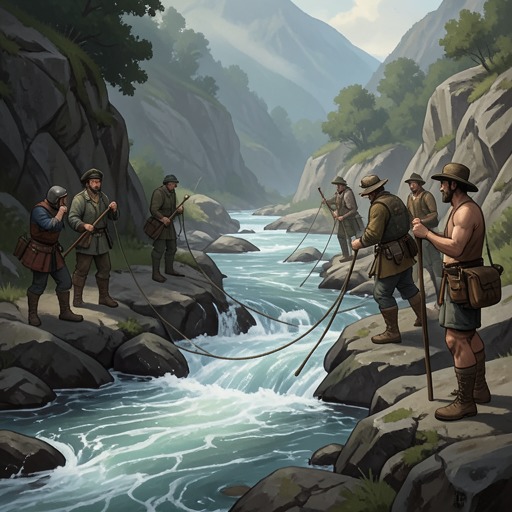
The hexagram’s central image is a young fox that has nearly crossed a stream but gets its tail immersed. The detail makes the danger one of premature confidence: most of the crossing may be behind the traveler, yet the last part can still go wrong. The commentary reads the fox as an emblem of insufficient caution among those trying to remedy prevailing disorder. Their attempts can fail and bring them into trouble and danger; the warning is not simply to try harder, but to recognize that the attempted method may be wrong and that the work must be undertaken another way.
The first line makes that peril immediate. Its subject is weak and stands at the bottom of the trigram of danger; responding to a strong line that is itself out of place, the subject attempts action and has cause to regret the course. Like the fox in the hexagram’s main image, this figure begins the crossing without securing the conditions for success. The warning attaches failure to the manner of acting, not merely to the difficulty of the stream.
The line texts also frame the crossing through vehicles and movement. In the second line, the subject drags back the carriage wheel; the commentary explains that this strong, central figure can restrain itself and keep the carriage from advancing. Here, holding back rather than pressing forward brings good fortune, provided the subject remains firm and correct. The contrast with the first line gives restraint a practical meaning: when progress would be rash, refusing to advance is itself an effective action.
Effort, Support, and Political Restoration
The fourth line turns from checking a premature move to pursuing restoration through sustained effort. Although its strong line occupies an even place, which could compromise its attempt to improve conditions, its subject is firm and correct. The ruler immediately above is represented by a weak line and is therefore humble and ready to welcome the effort. With that support, the subject is urged to exert himself vigorously and for a long time; progress and success are possible, but they depend on continued work rather than a single bold crossing.
The commentary compares this sustained exertion with Kâo Ȝung’s famous expedition. It also places military action in a practical political setting: expeditions beyond the frontiers were not very remote, communication continued between the army and the court, and rewards, distinctions, and necessary encouragement could be sent to the troops. The example gives the line’s call to perseverance a concrete institutional dimension. A campaign to improve conditions requires not only a determined leader but also support maintained between the center of authority and those carrying out the work.
The fifth line offers a complementary picture of leadership. Its subject is the ruler, represented by a weak line in an odd place, but supported by the strong second-line figure. The ruler’s humility and that support produce a particularly favorable auspice. The hexagram thus does not equate strength with solitary command: the ruler’s advantageous position comes through receptiveness and the backing of someone able to exercise strength with restraint.
Completion, Confidence, and the Need to Stop
At the top of the figure, the work of the hexagram has been done, and the subject appears ready to remain quiet, confident in his power and enjoying a feast. In that condition there is no error. Yet the line immediately places a limit on confidence: if it is cherished until the subject resembles the fox with its head immersed, it will fail of what is right. The ending distinguishes resting after work from continuing to test a perilous situation. Once the task has been done, quiet can be appropriate; renewed exertion for its own sake risks turning success into failure.
That final warning completes the hexagram’s pattern of measured action. The first line regrets action begun without due caution; the second finds good fortune in holding back; the fourth advances through prolonged effort and support; the fifth links good fortune to a humble ruler; and the sixth permits repose but warns against overconfidence. Together, these judgments make progress conditional rather than automatic. Not Yet Completed holds open the possibility of success while refusing to treat any stage—near arrival, vigorous effort, or apparent completion—as proof that danger has passed.